
Dame Jillian Sackler Director of the Arthur M. Sackler Gallery and Freer Gallery of Art
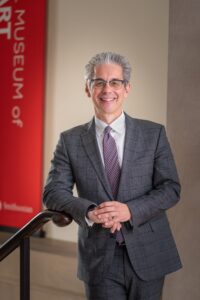
Chase F. Robinson has served as director of the Smithsonian’s National Museum of Asian Art since December 2018. During his tenure, the museum has launched initiatives that have significantly increased attendance on-site and online, expanded its collection by almost 6,000 works, doubled the size of its board of trustees, and grown the museum’s operating budget by 40%. Under his leadership, the museum has become a local and national hub for celebrating Asian arts and cultures and has placed itself at the center of an international network of collaborations. NMAA is also at the forefront of provenance research and ethical museum practice.
The author or editor of some nine books and dozens of scholarly articles, Robinson previously served as provost (2008–2013) and president (2013–2018) of the Graduate Center, the research campus of the City University of New York. From 1993 to 2008, Robinson was professor of Islamic history in the Faculty of Asian and Middle Eastern Studies at the University of Oxford and was Faculty Board Chair from 2003 to 2005. He received his baccalaureate from Brown University and his doctorate from Harvard University.
News and Remarks:
Statement from the Director (March 19, 2021)
A different Lunar New Year celebration in D.C. (February 10, 2021)
Director’s Introduction to the Museum for the Relay Project
(premiered September 2020)
This video presentation is part of the Treasure Hunt Relay: Global Museum Director’s Choice, a digital initiative of the National Museum of China dedicated to helping audiences learn remotely about the cultural treasures of national museums from around the world, in both Chinese and English. Within twenty-four hours of its launch, our program was enjoyed by over one million viewers.
After Pearl Harbor, our museum hid Asian art. In coronavirus crisis, we’re showing it off. (May 2, 2020)
Listen to Chase F. Robinson’s remarks at the “Age Old Cities” press preview
Listen to Chase F. Robinson’s remarks at the “Whistler in Watercolor” press preview
 Lori Duggan Gold is the Deputy Director for Operations and External Affairs of the Smithsonian’s National Museum of Asian Art. Duggan Gold joined the museum in January 2019. She brings more than thirty years of executive-level experience to the deputy director position. During her career, she has provided strategic planning and organizational guidance to publishing companies, educational institutions, cultural organizations, and government and nonprofit agencies.
Her professional experience also includes her work as the Director of Government Relations at the Brooklyn Botanic Garden and as Vice President for Communications at Adelphi University. Prior to joining the National Museum of Asian Art, Lori was Vice President for Communications and Public Affairs at The Graduate Center of the City University of New York. There, she oversaw marketing, communications, and public programming, among others. Lori received her BA in politics and metropolitan studies from New York University and her MA in emergency management from Adelphi University.
 Danielle Hall Bennett serves as the Deputy Director for Collections and Exhibitions at the National Museum of Asian Art. In this role, she oversees several departments, including collections management, conservation and scientific research, curatorial, exhibitions, and provenance. Prior to this position, she worked in the Collections Management department at the Walters Art Museum (Baltimore, MD) and served as President of the Association of Registrars and Collections Specialists from 2017 to 2020.
 Naoko Adachi is the Japan Foundation Assistant Curator of Japanese Art. She joined the Smithsonian’s National Museum of Asian Art in 2025. Specializing in Japanese prints, photographs, and crafts of the nineteenth century, she is particularly interested in the representation of Japanese identity for international audiences.
Adachi received her MA and PhD from the University of Pennsylvania. She has previously held positions at the Philadelphia Museum of Art, the Rijksmuseum in Amsterdam, and the Tokyo National Museum. In addition to her research on Meiji-era export objects, she has worked extensively on cataloguing the Arthur Tress Collection of Japanese Illustrated Books from the seventeenth to twentieth centuries.

Antonietta Catanzariti is Associate Curator for the Ancient Near East at the Smithsonian’s National Museum of Asian Art. She joined the museum in 2016 as a fellow and served as the Robert and Arlene Kogod Secretarial Scholar from 2018 to 2022. Catanzariti received her BA and MA from the Ca’ Foscari University of Venice, Italy, and a PhD in the art and archaeology of the ancient Near East from the University of California, Berkeley. She is an active archaeologist and has excavated in Italy, Jordan, Syria, Lebanon, and led the Qara Dagh Regional Archaeological Project (QDRAP), which conducted surveys and excavations in the Qara Dagh Valley, Iraqi Kurdistan. Since 2025 she has been excavating at the site of Kakavaberd, Armenia.
A specialist in the ceramic economy and art of the ancient Near East, Catanzariti is interested in the impact of landscape and trade routes on the formation and interactions of ancient communities. Catanzariti has lectured on topics related to the ancient Near East’s ceramic economy and her excavation projects. Since her arrival at NMAA, she has served as the in-house curator for Divine Felines: Cats of Ancient Egypt (2017) and curated Shaping Clay in Ancient Iran (2018), Ancient Yemen: Incense, Art, and Trade (2022), and A Collector’s Eye: Freer in Egypt (2023).

Dr. Debra Diamond, Elizabeth Moynihan Curator of South Asian and Southeast Asian Art at the National Museum of Asian Art, Smithsonian Institution, received her PhD from Columbia University in 2000.
A specialist in Indian court painting and the visual culture of yoga, her exhibitions received awards for excellence from the Smithsonian in 2023 and the Association of Art Museum Curators in 2013. Dr. Diamond’s commitment to presenting new ways of viewing Asian art and exploring new ways of curating runs through her exhibitions. Her most recent, Delighting Krishna: Paintings of the Child God (2024–25), was co-curated with Allen Richardson and members of the Hindu community. A Splendid Land: Paintings from Royal Udaipur (2022–23), co-curated with Dipti Khera, considered historical emotions and landscape ecologies. Encountering the Buddha: Art and Practice Across Asia (2017–22), co-curated with Robert DeCaroli and Rebecca Bloom, brought together objects and installations. Yoga: The Art of Transformation (2013), co-curated with Sita Reddy, presented yoga’s historical manifestations through an interrogation of its visual cultures. Finally, Garden and Cosmos: The Royal Paintings of Jodhpur (2008–09), co-curated with Karni Singh Jasol and Catherine Glynn Benkaim, was one of the first exhibitions to display the dazzling potential of nineteenth-century Indian painting.
Dr. Diamond has also curated numerous contemporary exhibitions at NMAA, including Perspectives: Simryn Gill (2006), Perspectives: Do-Ho Suh (2004), and Auto*Focus: Raghubir Singh’s Way into India (2003). From 2010 to the present day, she has curated several installations of the Tibetan Buddhist Shrine Room of Alice S. Kandell, an installation that seeks to restore aesthetic, cultural, and religious context to the display of Buddhist objects.
Dr. Diamond’s most recently published essay on painting, “Holi in the Zenana: Genre, Style and Sociability,” appeared in Readings in Painting (Mumbai 2024). Her Yoga catalogue was recognized with an award of Excellence from the Association of Art Museum Curators in 2013; the Garden & Cosmos catalogue received the College Art Association’s Alfred Barr Jr. Award for Museum Scholarship in 2009; and she was awarded Smithsonian Secretary’s Research Prizes in 2023, 2015, and 2010.
The Ebrahimi Family Curator of Persian, Arab, and Turkish Art, Senior Associate Director for Research

Massumeh Farhad joined the Smithsonian’s National Museum of Asian Art in 1995 as Associate Curator of Islamic Art. In 2004, she was appointed Chief Curator, a position she held until 2021. She currently serves as Senior Associate Director for Research and Director of the Freer Research Center. Dr. Farhad is also the editor of Ars Orientalis, one of the oldest journals dedicated to the arts of Asia in the United States. She is a specialist in the arts of the book from sixteenth- and seventeenth-century Iran. She has curated numerous exhibitions, including Art of the Persian Courts (1996), Style and Status: Imperial Costumes from Ottoman Turkey (2005–06), Falnama: The Book of Omens (2009–10), Roads of Arabia: History and Archaeology of the Kingdom of Saudi Arabia (2012), and The Art of the Qur’an: Treasures from the Museum of Turkish and Islamic Arts (2016).
Dr. Farhad received her PhD in Islamic Art History from Harvard University in 1987. Her publications include Slaves of the Shah: New Elites in Safavid Iran (2004), Falnama: The Book of Omens (2009), and The Art of the Qur’an: Treasures from the Museum of Turkish and Islamic Arts (2016). She was recently nominated the 2025 Smithsonian Distinguished Scholar.

Frank Feltens is Associate Director for Curatorial Affairs and Curator of Japanese Art at the National Museum of Asian Art. He received a PhD in Japanese art history from Columbia University. Feltens is a specialist in Japanese art with a focus on the late medieval and early modern periods. Additional interests include Japanese photography and the intersections between painting and ceramics.
Feltens has published and lectured on a range of topics related to Japanese art. He has written and co-authored books about the Japanese painters Katsushika Hokusai, Ogata Kōrin, the Zen monk-painter Sesson Shūkei, as well as Japanese literati painting. Prior to coming to the National Museum of Asian Art, he held research positions at the Museum of Modern Art, the National Museum of Asian Art in Berlin, and the Nezu Museum as well as at the temple Sensoji in Tokyo. At NMAA, Feltens has organized a number of exhibitions, including Imagined Neighbors: Japanese Visions of China, 1680–1980 (2024), Mind Over Matter: Zen in Medieval Japan (2022), Hokusai: Mad about Painting (2019/21), and Japan Modern: Prints in the Age of Photography (2018–19). Feltens is a longtime practitioner of the Japanese tea ceremony in the Urasenke tradition and carries the honorary tea name Söchoku.

Joanna M. Gohmann is the National Museum of Asian Art’s first Curator of Provenance Research and Object Histories. She joined the museum in 2019 and has worked to strengthen NMAA’s leadership in the field of provenance. As curator, Gohmann leads object history research across collection areas, coordinates NMAA’s ongoing international provenance research collaborations, and integrates provenance stories into NMAA’s web presence and galleries. Most recently, her work appeared in the exhibition Freer’s Global Network: Artists, Collectors, and Dealers.
Gohmann publishes and lectures on a range of topics related to provenance, art market histories and twenty-first-century museum practice. For George Washington University’s graduate program in museum studies, Gohmann offers a course on the fundamentals of provenance research. Gohmann holds a PhD in the history of art from the University of North Carolina at Chapel Hill. She is particularly interested in the histories of collecting and the market for Asian art in eighteenth- and nineteenth-century France. Before coming to NMAA, she held positions at the Walters Art Museum (Baltimore, MD), Offices of Historic Alexandria (Alexandria, VA), Ackland Art Museum (Chapel Hill, NC), and the National Gallery of Art (Washington, DC).
Lunder Curator of American Art and Associate Director of Curatorial Affairs

Dr. Diana Greenwold specializes in late nineteenth- and early twentieth-century American fine and decorative arts. She recently curated two exhibitions, Ruffled Feathers: Creating Whistler’s Peacock Room (2024) and the Terra-sponsored Shifting Boundaries: Perspectives on American Landscapes (2024). She is currently working on projects on Whistler, the art and culture of American Chinatowns, and co-leading the reinstallation of the Freer Galleries. From 2014 to 2021, Greenwold served in various curatorial positions, ultimately as Curator of American Art at the Portland Museum of Art in Portland, Maine. There, she oversaw the museum’s collection of over 11,000 American paintings, sculptures, and decorative arts. Her exhibitions included two National Endowment for the Humanities–funded projects: Mythmakers: The Art of Winslow Homer and Frederic Remington (2020) and In the Vanguard: Haystack Mountain School of Crafts, 1950–1969 (2018). Greenwold also spearheaded the multistage reinterpretation of the Winslow Homer Studio.
 Carol Huh is Associate Curator of Contemporary Asian Art at the Smithsonian’s National Museum of Asian Art. Her work focuses on late twentieth and twenty-first century art related to Asia through exhibitions and acquisitions. Exhibition projects include Saodat Ismailova (upcoming), Body Transformed: Contemporary South Asian Photographs and Prints (2025), Park Chang-kyong: Gathering (2023–24), Unstill Waters: Contemporary Photography from India (2022–23), Living in Two Times: Photography by Bahman Jalali and Rana Javadi (2022), My Iran: Six Women Photographers (2019–20), Japan Modern: Photographs from the Gloria Katz and Willard Huyck Collection (2018–19), Notes from the Desert: Photographs by Gauri Gill (2016–17), Symbolic Cities: The Work of Ahmed Mater (2016), Nine Deaths, Two Births: Xu Bing’s Phoenix Project (2013), and Shadow Sites: Recent Work by Jananne Al-Ani (2012–13). Others include the museum’s first series of video art from Asia (2014) and annual contemporary art installations featuring works by Do Ho Suh, Y.Z. Kami, Minouk Lim, Rina Banerjee, Michael Joo, and Subodh Gupta, among others. Huh is a founding member of the Smithsonian Artist Research Fellowship Committee and completed her undergraduate and graduate studies at Georgetown University.
 Sunwoo Hwang is the Korea Foundation Assistant Curator of Korean Art and Culture at the Smithsonian’s National Museum of Asian Art. Appointed in 2024 as the museum’s first Curator of Korean art, she specializes in Korean and Chinese Buddhist art with a focus on medieval Buddhist wall paintings and their iconographic significance.
Hwang holds an MA in humanities from the University of Chicago and a PhD in art history from Dongguk University in South Korea. From 2018 to 2024, Hwang served as the Korean Program Associate at NMAA. She contributed to the exhibitions Sacred Dedication: A Korean Buddhist Masterpiece (2019) and Once Upon a Roof: Vanished Korean Architecture (2022), and she organized Korean Treasures: Collected, Cherished, Shared (2025).

Sol Jung is the inaugural Shirley Z. Johnson Assistant Curator of Japanese Art at the Smithsonian’s National Museum of Asian Art where she oversees the museum’s collection of prehistoric to contemporary Japanese ceramics, lacquerware, metalwork, and textiles. Jung specializes in Japanese art history with a focus on how transnational maritime trade impacted Japan’s visual culture during the premodern period. She received her BA with distinction in history of art at the University of Pennsylvania and her MA and PhD in art and archaeology from Princeton University. Jung curated Princeton University Art Museum’s first thematic exhibition of Korean ceramics entitled Korean Ceramics: From Archaeology to Art History.
Jung has examined the reception of Korean tea bowls, called kōrai chawan in Japan, during the sixteenth century. Fieldwork at several maritime settlement sites in Japan and analysis of period tea documents, literary texts, and archaeological remains have informed her research, which has been supported by the Metropolitan Center for Far Eastern Art Studies and the Kyujanggak International Center for Korean Studies.
She has curated the exhibitions Knotted Clay: Raku Ceramics and Tea (2023–ongoing), Striking Objects: Contemporary Japanese Metalwork (2024–26), and Reasons to Gather: Japanese Tea Practice Unwrapped (2025–26), among others. Jung is a team member of the Teaching Tea project through Japan Past and Present, a global information hub that is a part of the Yanai Initiative for Globalizing the Japanese Humanities at UCLA and Waseda University.

Simon Rettig is the Associate Curator for the Arts of the Islamic World at the Smithsonian’s National Museum of Asian Art. He previously worked at the French Research Institute of Anatolian Studies in Istanbul and the Freie Üniversität in Berlin. Rettig received a BA from the École du Louvre in Paris and his MA and Doctorate from the Université de Provence Aix-Marseille I, France.
Between 2012 and 2016, he was the curatorial fellow for the arts of the Islamic World at NMAA. Rettig curated the exhibition Nasta‘liq: The Genius of Persian Calligraphy (2014), The Prince and the Shah: Royal Portraits from Qajar Iran (2018), and was the co-curator with Massumeh Farhad of The Art of the Qur’an: Treasures from the Museum of Turkish and Islamic Arts (2016). In 2020, he served as the in-house curator in charge of the exhibition Age Old Cities: A Virtual Journey from Palmyra to Mosul. His current projects include the preparation of an exhibition on the Great Mongol Shahnama (scheduled for 2024) and a monograph on the Freer’s celebrated Khusraw u Shirin manuscript.
Jeffrey P. Cunard Curator of Southeast Asian Art

Emma Natalya Stein joined the curatorial staff at the National Museum of Asian Art after completing her PhD in the history of art at Yale (2017). Her exhibitions at NMAA include Vishnu’s Cosmic Ocean; Prehistoric Spirals: Earthenware from Thailand; Revealing Krishna: Journey to Cambodia’s Sacred Mountain; Power in Southeast Asia; and The Art of Knowing in South Asia, Southeast Asia, and the Himalayas. Dr. Stein is author of the monograph Constructing Kanchi: City of Infinite Temples (Amsterdam University Press, 2021) and articles on topics including yoginis, temple networks, and cultural heritage. She currently serves on the boards of the American Council for Southern Asian Art and the journal Ars Orientalis. Her research is grounded in fieldwork in both South Asia and Southeast Asia, where she documents and maps monuments in diverse landscapes and regularly contributes to workshops, conferences, and collaborative projects.

Jan Stuart became the first Melvin R. Seiden Curator of Chinese Art in 2014 after serving as Keeper of Asia (department head) at the British Museum from 2006 to 2014. There, in addition to senior management responsibilities, she led a project to create a new gallery for the Sir Percival David collection of Chinese ceramics. At NMAA, her curatorial focus is on Chinese arts from the tenth century through the contemporary period, with primary emphasis on ceramics, decorative arts, textiles, and court arts, and a secondary emphasis on paintings. Stuart is active in museum acquisitions and publishes and lectures regularly.
Recent exhibitions with related publications at NMAA include Palace Life Unfolds: Conserving A Chinese Lacquer Screen (2023–24) and Empresses of China’s Forbidden City, 1644–1912 with Daisy Yiyou Wang, co-organized with the Peabody Essex Museum (Salem, MA) and the Palace Museum (Beijing) in 2018–19. Stuart was awarded the Secretary of the Smithsonian’s Research Prize in 2019 for the catalogue. Other projects include regularly changing the Chinese paintings on view after participating in the 2017 renovation of the Freer Gallery. Additional exhibitions with publications include Red: Ming Dynasty/Mark Rothko (2016), Worshiping the Ancestors: Chinese Commemorative Portraits with Evelyn Rawski (2001), Return of the Buddha: The Qingzhou Discoveries (2004), Joined Colors: Decoration and Meaning in Chinese Porcelain with Louise Allison Cort (1993), and Challenging the Past: The Paintings of Chang Dai-chien with Shen Fu (1991).
Prior to her position at the British Museum, Stuart began her career as a curator at the Smithsonian’s National Museum of Asian Art after holding a Mellon Fellowship at the Metropolitan Museum of Art and earning undergraduate and graduate degrees from Princeton and Yale in Chinese art, language, and culture.
 Tom Vick is the Curator of Film at the Smithsonian’s National Museum of Asian Art. Formerly, Vick was the Coordinator of Film Programs at the Los Angeles County Museum of Art. He has worked as a consultant for the International Film Festival Rotterdam and served on the juries of the Korean Film Festival in Los Angeles, the Fantasia International Film Festival in Montreal, Filmfest DC, and the Smithsonian African American Film Festival. He has contributed essays to Directory of World Cinema: Japan, Film Festival Yearbook, Asian Geographic, and other publications. He is the author of Asian Cinema: A Field Guide (2007) and Time and Place Are Nonsense: The Films of Seijun Suzuki (2015). He is the executive producer on Tsai Ming-liang’s film Abiding Nowhere (2024) and contributed a video essay to the Blu-ray release of Shohei Imamura’s film Warm Water Under a Red Bridge in 2023.
June and Simon K.C. Li Curator of Chinese Art

A specialist in Chinese antiquities, J. Keith Wilson received his BA in Chinese studies from Williams College (1978) and completed his PhD coursework at Princeton University (1988) after receiving MAs in Chinese art and archaeology from both the University of Michigan (1983) and Princeton (1985). He was appointed Curator at the Cleveland Museum of Art (1988–96) and Chief Curator of Asian Art at the Los Angeles County Museum of Art (1996–2006) before joining the staff of the Smithsonian’s National Museum of Asian Art in 2006.
In the past two decades in Washington, DC, he has reinstalled the ancient Chinese art collection in the Freer Gallery of Art twice and curated numerous special exhibitions that include Resound: Ancient Bells of China (2017) and Anyang: China’s Ancient City of Kings (2023). He has also contributed to several Chinese and Korean Buddhist exhibitions with publications, including Echoes of the Past: The Buddhist Cave Temples of Xiangtangshan (2011), Sacred Dedication: A Korean Buddhist Masterpiece (2019–20), and Once Upon a Roof: Vanished Korean Architecture (2022). Two others—Body of Devotion (2015–16) and Goryeo Buddhist Paintings: A Closer Look (2019)—resulted in a rich menu of digital features hosted on the museum’s website. Most recently, he completed Jades for Life and Death, a comprehensive digital catalogue dedicated to one thousand ancient Chinese jades in the museum’s collection (launched 2024), and co-curated the major exhibition Korean Treasures: Collected, Cherished, Shared (2025), which drew from the collections donated to the national museums of Korea by the family of former Samsung Chairman Lee Kun-hee.
